
The CNC Router Machine for Kitchen Cabinets, Wardrobes, and Custom Home Furniture is a high-efficiency woodworking automation solution designed for modern furniture manufacturing. It is widely used in cabinet factories, custom furniture workshops, interior design companies, and large-scale panel furniture production lines.
With the rise of customized home furnishing and smart manufacturing, CNC router systems have become the core equipment for producing kitchen cabinets, wardrobes, closets, TV cabinets, office furniture, and modular furniture systems.
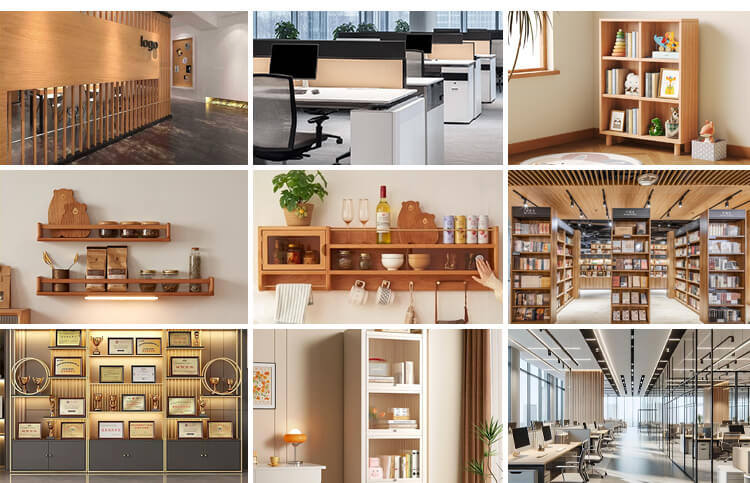
CNC Router Machine for Kitchen Cabinets
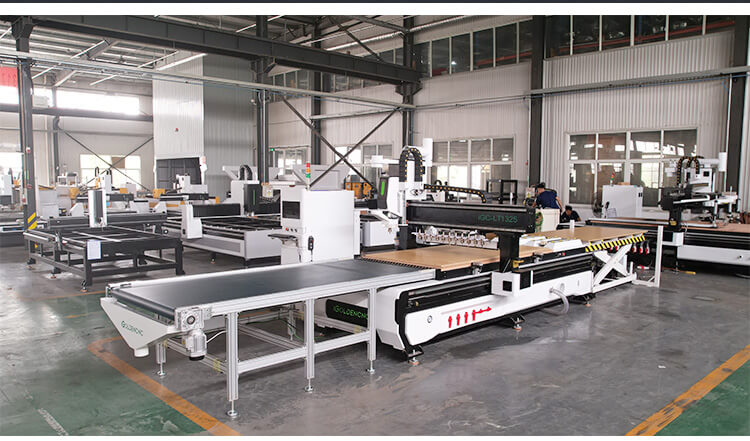
This project focuses on the production of various types of panel furniture, including kitchen cabinets, wardrobes, office furniture, and custom storage units. These products are typically made from materials such as solid wood, medium-density fiberboard (MDF), plywood, and particleboard, and require precise cutting, drilling, and routing, as well as accurate component labeling to ensure proper assembly.
Unlike traditional mass production, modern panel furniture manufacturing increasingly emphasizes customization. Each project may involve different dimensions, structures, and hole patterns, placing higher demands on machining precision and production flexibility. As a result, manufacturers need a more advanced woodworking CNC router machine that can handle diverse designs while maintaining consistent quality.
The production process for such projects typically includes:
- Panel cutting and nesting
- Drilling for connectors and hardware
- Routing for back panels or structural components
- Labeling for identification and assembly
To complete these steps, many factories still rely on a combination of multiple standalone machines, such as a CNC router for woodworking for cutting and separate equipment for drilling. While this setup can meet basic production needs, it often falls short of the efficiency and precision required for large-scale or custom orders.
Another key requirement for panel furniture projects is workflow organization. Since each order may involve dozens or even hundreds of panels, accurate identification and seamless process coordination are critical. Without an integrated system, managing these components becomes increasingly complex as production volume grows.
Consequently, for cabinetry, wardrobes, and other custom furniture projects, manufacturers are seeking more integrated CNC router machinery solutions. A modern wood machine router that combines cutting, drilling, and labeling functions can significantly streamline the production process, reduce manual intervention, and improve overall efficiency.
This is precisely the production scenario where multifunctional wooden router machine – such as CNC router with labeling and drilling capabilities – can truly demonstrate their value.

Actual Processing Workflow
1. Program Setup and Data Import
CNC files are designed using CAD software, and CAM software converts the design files into toolpath code that the CNC machine can read. In other words, the operator imports design files from CAD/CAM or furniture design software (such as cabinet design systems). The software can automatically generate nesting layouts to optimize material utilization and reduce waste.
2. Panel Loading and Automatic Positioning
At the start of processing, the sheet material is placed on the worktable. A vacuum suction system quickly secures the sheet in place, ensuring it remains stable during high-speed machining. Simultaneously, the system reads the production data and prepares for subsequent steps. This replaces the traditional manual positioning process, ensuring consistent accuracy from the very beginning. Like most CNC machining processes, the machine operates according to pre-programmed instructions, achieving precise and repeatable machining without human intervention.
3. Automatic Labeling
Before cutting begins, the machine automatically prints labels and applies them to the panel. The labels contain all necessary production information, such as part numbers and machining data.
4. Nesting and Cutting
After labeling, the spindle begins the cutting process. The high-power 9kW spindle operates at high speed, efficiently cutting the sheet material along optimized nesting paths. The machine moves along the X, Y, and Z axes, precisely executing the preset toolpaths to ensure accurate dimensions and smooth edges.
5. Automatic Tool Change for Multi-Process Machining
To perform different operations, the machine uses a disc-type automatic tool changer to automatically switch tools. The system selects the correct tool and resumes machining within seconds without stopping the machine or requiring manual tool changes.
6. Drilling and Routing
The 5+4-axis drilling unit performs vertical and horizontal drilling without the need to move the panel to another machine. Additionally, the 4-axis spindle can perform auxiliary machining as needed.
7. Completion
Once all processes are complete, the finished panel is ready for the next stage of processing, such as edge banding or assembly.
Materials Used in Cabinet & Wardrobe Manufacturing
A CNC furniture router can process a wide range of materials:
Wood-Based Panels
- MDF (Medium Density Fiberboard)
- Plywood
- Particle board
- Melamine board
- OSB board
Solid Wood & Softwood
- Oak
- Pine
- Walnut
- Birch
Decorative Materials
- Acrylic panels
- PVC sheets
- Laminate boards
- Veneer panels
Why CNC Router Machines Are Essential for Modern Furniture Industry
The global furniture industry is shifting toward:
- Customization
- Mass personalization
- Smart factory automation
- High efficiency production
CNC router machines enable manufacturers to:
- Respond quickly to customer orders
- Reduce production time
- Improve product quality
- Optimize material usage
FAQ
Q1: What is the best CNC router for kitchen cabinets?
The best option is a Nesting CNC Router or ATC CNC Router, depending on production scale and automation needs.
Q2: Can CNC routers make wardrobes and closets?
Yes. CNC machines are widely used for cutting and producing wardrobe panels, sliding doors, and storage systems.
Q3: What materials can be used in furniture CNC machining?
MDF, plywood, particle board, solid wood, and decorative panels are commonly used.
Q4: Is CNC furniture production suitable for small workshops?
Yes. Entry-level CNC routers and double-head machines are ideal for small and medium workshops.
Q5: What software is used for cabinet design?
Common software includes Cabinet Vision, AutoCAD, Alphacam, and other CAD/CAM systems.
IGOLDEN BLOG
Thank you for visiting the iGOLDENCNC website. iGOLDENCNC is the professional supplier of CNC machinery application solution, within the business of producing and selling CNC machinery and accessories.