
The marine industry builds its products from molds. Every fiberglass hull, every composite deck structure, every gel-coated surface panel on a production powerboat, sailing yacht, or commercial vessel begins its life as a precisely machined mold — a negative form whose dimensional accuracy, surface finish quality, and geometric fidelity directly determine the quality of every part produced from it over its service life. A mold that is accurate to specification produces parts that fit, assemble correctly, and perform as designed. A mold with geometric errors, surface finish deficiencies, or dimensional drift from its digital design produces parts that require correction on every pull — compounding the original mold machining error across hundreds or thousands of production cycles.
Marine molds are among the most demanding workpieces in large-format CNC machining. They are large — boat hull molds routinely measure 12 to 30 meters in length and 3 to 6 meters in beam. They are geometrically complex — the compound curved surfaces of a modern hull form involve continuous transitions between convex and concave geometry, sharp bow entries, flared topsides, and reverse curves at the transom that demand simultaneous multi-axis tool motion to machine without faceting, step errors, or surface discontinuities. And they are expensive — the material cost of a large foam or tooling board mold blank, combined with the machine time required to produce it, means that machining errors discovered after the fact are not merely inconvenient but financially serious.
The IGOLDENCNC Large-Format 5-Axis CNC Router is engineered to meet these demands. With a working envelope sized for the largest marine mold applications, five simultaneously interpolated axes of motion that handle any marine hull geometry without repositioning, and the spindle power and structural rigidity that large-format composite mold machining requires, it gives marine mold builders the precision manufacturing capability that the modern production boat industry demands.
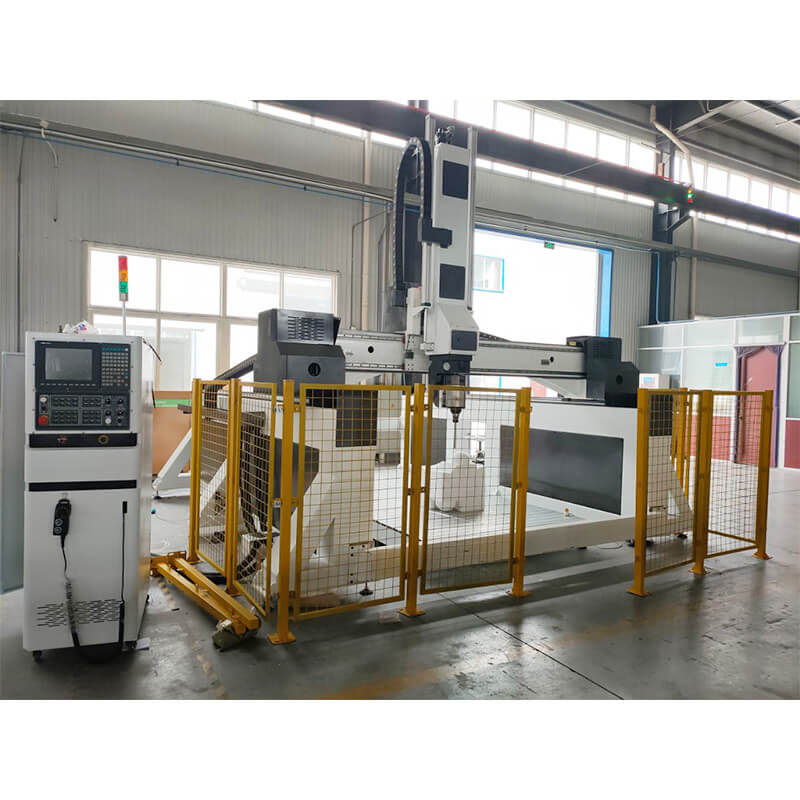
This guide gives you a complete, practical understanding of large-scale marine mold machining with the IGOLDENCNC 5-Axis CNC Router — the materials involved, the geometric challenges that make 5-axis capability essential, the machine specifications that matter, and the operational practices that deliver consistent mold quality across every project.
5-Axis CNC Technology
Marine hull molds are not simply large flat or single-curvature surfaces that a 3-axis CNC router can approximate adequately. They are complex three-dimensional forms whose geometric characteristics specifically require simultaneous 5-axis motion to machine correctly and efficiently.
Compound Curved Surfaces Throughout
A modern production boat hull is a continuously compound-curved surface — every point on the hull has curvature in multiple directions simultaneously, and those curvatures transition continuously from bow to stern, from keel to gunwale, without flat or single-curvature zones that would simplify the machining geometry. The bow entry transitions from a sharp, near-vertical angle at the waterline to a flared, nearly horizontal surface at the deck. The topsides transition from vertical amidships to dramatically flared forward sections and tucked-under aft sections near the transom. The bilge radius transitions from a hard chine on a planing hull to a continuous compound curve on a round-bilge displacement design.
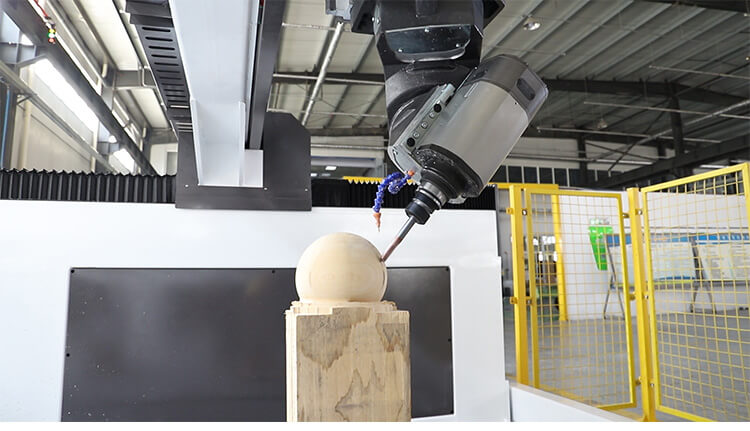
On a 3-axis CNC router, machining these continuously transitioning compound curves requires the cutter to approach the surface from the fixed vertical spindle orientation — producing the classic 3-axis surface machining result of a series of closely-spaced horizontal step cuts whose quality is determined entirely by the step-over distance between passes. Achieving acceptable surface quality on marine mold compound surfaces with 3-axis machining requires extremely fine step-over distances — adding enormous machine time — and still produces a scalloped surface topology that requires hand fairing to bring to gel-coat quality. On a 5-axis CNC router, the cutting tool tilts to maintain the optimal angle relative to the surface normal throughout every toolpath pass — eliminating scalloping, enabling wider step-over distances without quality compromise, and producing surfaces that require minimal hand finishing.
Undercut Geometry on Hull Forms
Many modern hull forms — particularly high-performance planing hulls with hard chines, sailing yacht hulls with deep fin keel pockets, and powerboat hulls with propeller tunnel recesses — include undercut geometry: surfaces that are inaccessible to a vertically mounted cutting tool because they face downward or sideways relative to the mold orientation. These features are not design oddities — they are functional requirements of the hull form that must be machined to specification in the mold for the production hull to match its design. On a 3-axis router, undercuts require either mold construction in multiple sections that are later assembled — introducing alignment errors at every joint — or acceptance that the undercut geometry will be hand-shaped and faired, introducing the dimensional inconsistency that hand work always creates. On the IGOLDENCNC 5-axis system, the cutting head tilts and rotates to reach undercut surfaces directly in the same machining setup as the main hull surface.
Large Mold Scale Requires Uninterrupted Single-Setup Machining
A 10-meter boat hull mold is a single continuous surface. Machining it in sections — limited by a CNC router’s working envelope — and joining those sections introduces alignment errors at every seam that propagate into every hull pulled from the mold for the mold’s entire service life. The IGOLDENCNC large-format 5-axis system’s extended working envelope processes full-length marine molds in a single continuous setup — the only approach that delivers the dimensional continuity that production hull quality demands across the full length of the mold.
Surface Normal Alignment for Gel Coat Quality
Marine mold surface quality is not simply a matter of dimensional accuracy — it is a matter of surface texture and waviness at the scale that gel coat finish quality depends on. A mold surface with even minor waviness — undulations in the 1–5mm amplitude, 50–200mm wavelength range — produces gel coat surfaces that show the waviness in reflection, requiring significant hand polishing to correct on every production hull. The IGOLDENCNC 5-axis system’s ability to maintain optimal tool angle relative to the surface normal throughout every toolpath pass eliminates the surface waviness that 3-axis machining introduces — producing mold surfaces that translate directly to production hull gel coat quality without the hand finishing that 3-axis mold surfaces require.
Key Components of the IGOLDENCNC Large-Format 5-Axis System
Understanding the major components of the IGOLDENCNC large-format 5-axis CNC router helps you evaluate machine specifications against the specific demands of marine mold machining.
Extended Working Envelope Gantry Frame
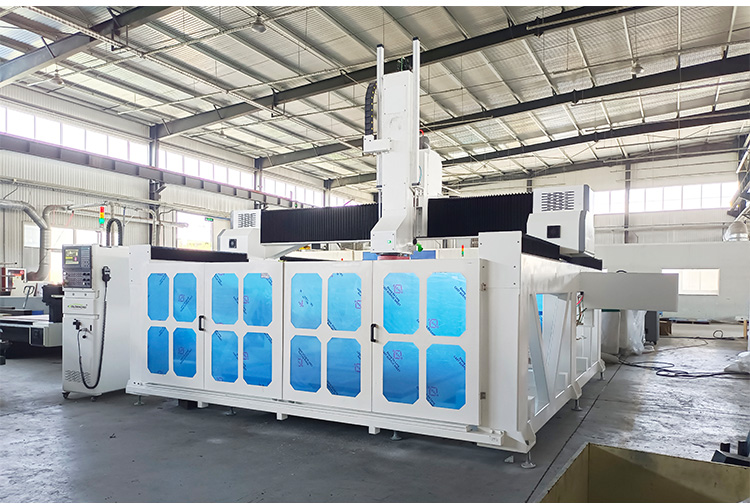
The IGOLDENCNC large-format marine mold system is built on a heavy welded steel gantry frame with X-axis travel extending to 30 meters or beyond for the largest production boat hull molds — configurable in standard increments to match the mold lengths your production requires. The gantry crossbeam spans 4–8 meters of Y-axis width to cover the beam dimension of the molds being machined, and the Z-axis stroke provides adequate clearance for the full height variation of deep-keel sailing yacht molds and high-freeboard powerboat designs. Frame rigidity across this extended working envelope is the most demanding structural engineering challenge in large-format marine mold machine design — the IGOLDENCNC frame uses finite element analysis-optimized cross-section geometry and precision-machined rail mounting surfaces to maintain positional accuracy across the full working volume that shorter machines never need to address.
High-Torque 5-Axis Milling Head
The IGOLDENCNC 5-axis head for marine mold applications uses a fork-style or nutating head configuration — providing the A and C axis rotational range required to reach all marine hull geometry including undercut sections and sharply angled bow entry forms. The head carries a high-torque spindle with HSK interface rated for the sustained large-diameter cutter loads of marine tooling foam and board machining — power ratings from 18 kW to 37 kW depending on configuration, matched to the material removal rates that large mold roughing operations demand. The head’s angular axis range — typically A: ±110° and C: 360° continuous — covers the full geometric range of production marine hull forms without axis limit interference during any standard mold toolpath.
High-Speed Spindle with ATC
For a complete marine mold machining workflow — from large-diameter roughing cutters through medium semi-finishing to fine ball nose finishing — an automatic tool changer with 20–40 tool positions allows the IGOLDENCNC system to execute the complete roughing-to-finishing sequence without operator tool changes between operations. Tool holders are pre-set with all required cutters before machining begins, and the controller manages the tool change sequence automatically as each machining stage transitions to the next. On a large marine mold with 40–80 hours of total machine time, the elimination of manual tool change interruptions is both a productivity gain and a quality assurance benefit — each tool in the ATC is pre-measured for length offset, eliminating the depth variation that manual tool changes introduce.
Precision Linear Rail System — Extended Length
X-axis rails on large-format IGOLDENCNC marine mold systems extend to the full machine length — requiring precision ground hardened steel rail sections joined with sub-micron alignment accuracy at each section joint. Rail joint alignment is the most critical geometric specification in extended-length machine construction — a 5-micron height error at a rail joint produces a detectable surface discontinuity in the mold at the corresponding X-axis position that will appear as a step defect on every hull pulled from that location for the mold’s entire service life. IGOLDENCNC’s rail joining procedure uses precision alignment fixtures and laser interferometer verification to achieve rail continuity at extended joints that meets the machine’s overall positional accuracy specification.
Volumetric Accuracy Compensation System
Over the extended working envelope of a large marine mold machine — 20+ meters in X, 4+ meters in Y, 1.5+ meters in Z — geometric errors including axis straightness, axis squareness, and thermal expansion accumulate to levels that significantly exceed the machine’s per-axis positional accuracy specification. The IGOLDENCNC volumetric accuracy compensation system characterizes these geometric errors across the full working volume using laser tracker measurement, and stores compensation maps that the controller applies in real time to correct axis position commands for the measured geometric error at each location. The result is a machine whose positional accuracy in three-dimensional space across its full working envelope significantly exceeds what the individual axis accuracy specifications would predict — essential for achieving consistent surface quality across the full length and beam of a large marine mold.
Mold Support & Fixture System
Large marine molds — assembled from bonded foam or tooling board panels on a steel supporting framework — must be supported and fixtured on the IGOLDENCNC table in a way that prevents movement during machining while accommodating the mold’s irregular underside geometry and providing access for the gantry and head to reach all required machining positions. IGOLDENCNC’s marine mold fixture system uses adjustable jack stands with leveling capability and clamping fixtures that secure the mold framework to the machine table while allowing the mold’s height and angular position to be adjusted for optimal machining access. For very large molds, integrated in-process measurement — using a touch probe mounted in the ATC — verifies the mold’s position relative to the machine coordinate system and updates the part origin before each machining stage.
I did a research online for multi axis CNC router for three months, and I inspected five CNC machine manufacturers from German and China, finally, I made a decision from the quality, technique, skill, power and price, I bought it from iGOLDENCNC. 30 days later, I got the machine with 7 days door-to-door training at the same time. Now I can use the machine easily for 3D mold making, I have to say, it’s a great buy for me.