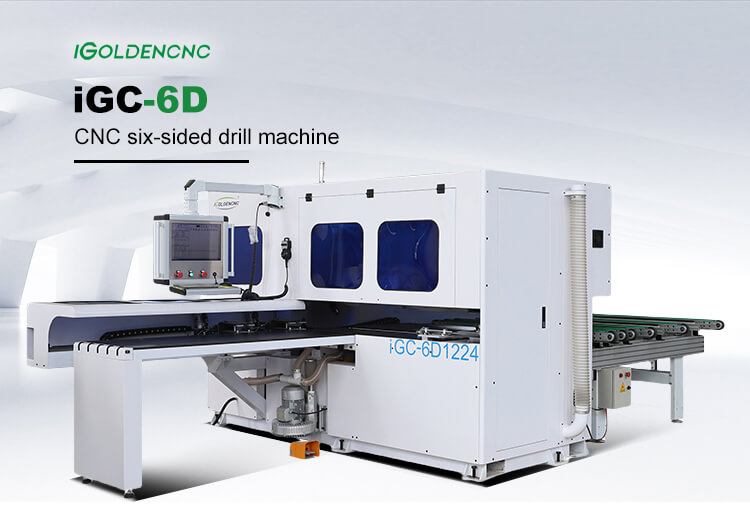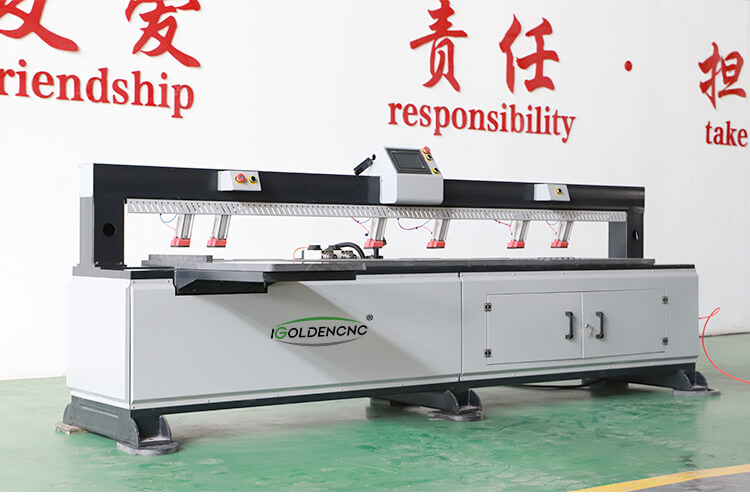
Handle-free Side Hole Drilling Machine
It is a CNC woodworking machine designed for side-hole drilling and supported grooving operations on compatible panel furniture components. The exact machining functions depend on the model and tool configuration.


Side Hole Drilling Machine
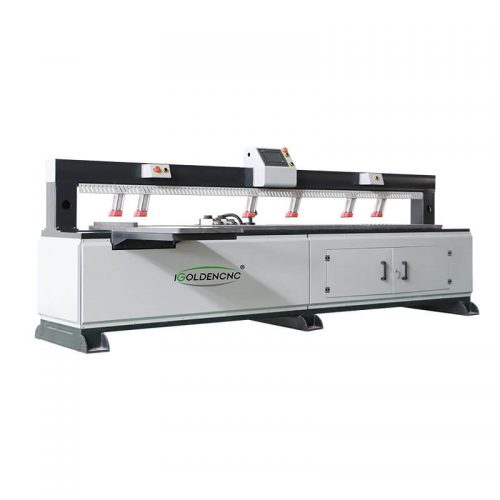
A four-process handle-free side hole drilling machine is a dedicated CNC work center that drills edge holes and mills handle-free grooves into cabinet doors, wardrobe doors and wall panels in a single clamping cycle. Four independent tooling positions — typically two drilling spindles and two grooving spindles — work along the panel edge, so a door that needs hinge-side holes, a 3-in-1 connector bore, a J-profile finger recess and a lamp groove leaves the table finished instead of being carried to a second machine.
The Four-Process Handle-Free Side Hole Drilling Machine is designed for panel furniture manufacturers who require efficient side-hole drilling and handle-free grooving for cabinet panels and customized furniture components.
Side Hole Drilling Machine Video
Parameter
| Technical indicators | parameter |
| Fuselage specification | 3600*1300*1450mm |
| Bench height | 750mm |
| X axis working stroke | 0-2800mm |
| Z axis working stroke | 0-50mm |
| Max. sheet size (l * w * t) | 2800*1300*50mm |
| Working speed | 10-80m/min |
| Guide rail | 20 square guide rails |
| Table | PVC |
| Control system | Scanning code scanning dual system |
| Laser pickoff | American Bonner laser head |
| Spindle motor power | T1/T2 3.5kw T3/T4 2.2kw |
| Screen | 7 inch touch screen |
| Motor | DORAN servo motor |
| Main Functions: 3-in-1 Connectors / Grooving / Various Hardware Handles, Push-to-Open Systems, and Concealed Fittings (such as Dübel, LOCK, Lamello, etc.) | |

Four spindle
Can be processed: 3-in-1 / pull groove/all kinds of hardware handle, handle free, all kinds of invisible parts (mortise and tenon, wood, buckle, Lamino, etc.)

US Banner laser probe
The machine is equipped with a Bonner laser probe for 100% leak-free drilling.

Air cylinder
The compaction of the whole machine is full cylinder operation, easy to operate. Interval positioning piles are suitable for materials of all sizes.

Operation panel
PLC integrated control, stable and efficient.
Application
Four-step handle-free side hole drilling machine can process door panels, wardrobe door panels, wall panel fasteners and other workpieces. The processing technologies include hinge holes, laminos, three-in-one connectors, handle-free slots, lamp slots, straightener slots, frame handle slots, etc.


It refers to four independent tooling positions on one frame — normally two drilling spindles and two milling spindles — which let a single program drill and groove the same panel edge without a tool change or a second clamping.
A side hole is bored into the narrow edge face of a panel, perpendicular to the face, and receives dowels, cam bolts, 3-in-1 connectors, shelf pins and hinge plate screws. Drilling it with the panel lying flat is faster and more repeatable than standing the panel on edge.
A six-sided center bores all faces of flat-pack panels, including the panel face. A side hole machine works the edge only, and adds handle-free and lamp grooving that a six-sided head layout typically cannot reach. Most plants use both rather than choosing.
A side hole is bored into the narrow edge face of a panel, perpendicular to the face — the hole that receives a dowel, a cam bolt, a 3-in-1 connector, a shelf pin or a hinge plate screw. On a generic drill press or a vertical CNC, that hole requires the panel to stand on edge, which is slow to load and hard to clamp repeatably on thin doors. A side hole machine keeps the panel flat on a 750 mm-high table and brings horizontal spindles to the edge instead.
The “four-process” part of the name describes the tooling arrangement rather than four passes. Four independently controlled heads let one program drill, bore and mill on the same edge without an operator changing a bit or re-referencing the workpiece. Suppliers describe the resulting operations as hinge holes, Lamello (laminae) slots, three-in-one connector bores, handle-free grooves, lamp grooves, straightener grooves and frame handle grooves.
A handle-free (handleless) cabinet has no knob and no pull. The door is opened by a finger recess milled into the edge, by a J-profile or C-channel aluminium rail set into a groove, or by a G-profile strip that wraps the edge. All three approaches depend on a groove of consistent depth, width and setback — cut in the same operation as the hinge and connector boring, or the door will not hang square against the carcass.
This is why the handle-free capability sits on the side-hole machine rather than on a separate router. The groove is a locating feature for both the opening mechanism and, frequently, the door’s edge alignment.

Reviews

This side drilling machine has transformed our production line! The precision is outstanding, and it handles heavy-duty materials with ease. Setup was straightforward, and it has significantly reduced our drilling time. A must-have for any woodworking shop!
We needed a reliable side drilling solution for our custom furniture business, and this machine exceeded our expectations. The accuracy is perfect, and the automated features save us so much time. The build quality is excellent—worth every penny!

Great machine for the price! The drilling speed and precision are impressive, though we occasionally need to adjust the settings for different wood densities. Customer support was helpful in resolving minor issues quickly. Highly recommended.
This side drilling machine is a game-changer for our cabinetry business. It’s fast, accurate, and incredibly easy to operate. The durability and low maintenance make it a smart long-term investment. Our productivity has improved by at least 30%!
We are grateful for your help with everything. This was a wonderful experience. We can not thank you enough. Everything is great.
I use this machine to make electric guitars. Blue Elephant is really a professional CNC machine manufacturer. Recommend.