
A CNC stone cutting bridge saw is an industrial stone fabrication machine designed to accurately cut marble, granite, quartz, porcelain, ceramic slabs, sintered stone, and other hard materials. With CNC-controlled movement, a diamond saw blade, and multi-axis positioning, the machine can perform straight cutting, angle cutting, miter cutting, stair fabrication, floor tile cutting, countertop cutting, and other customized stone processing operations.
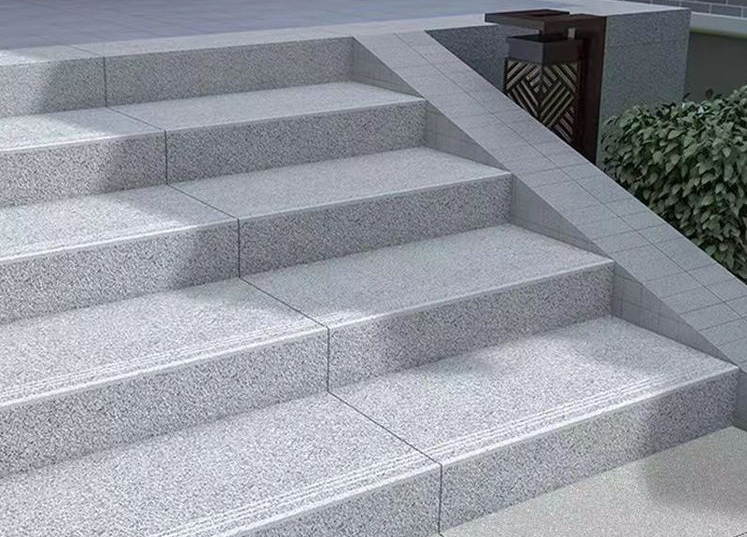
For stone fabrication companies, construction material manufacturers, tile processors, and interior decoration businesses, a CNC bridge saw for tile, stair and floor provides a flexible solution for producing accurately sized stone components with consistent quality.
Modern 4-axis and 5-axis CNC bridge saws can also perform more advanced operations such as miter cuts, curved cuts, sink openings, edge profiling, drilling, and milling, depending on the machine configuration.
What Is a CNC Stone Cutting Bridge Saw?
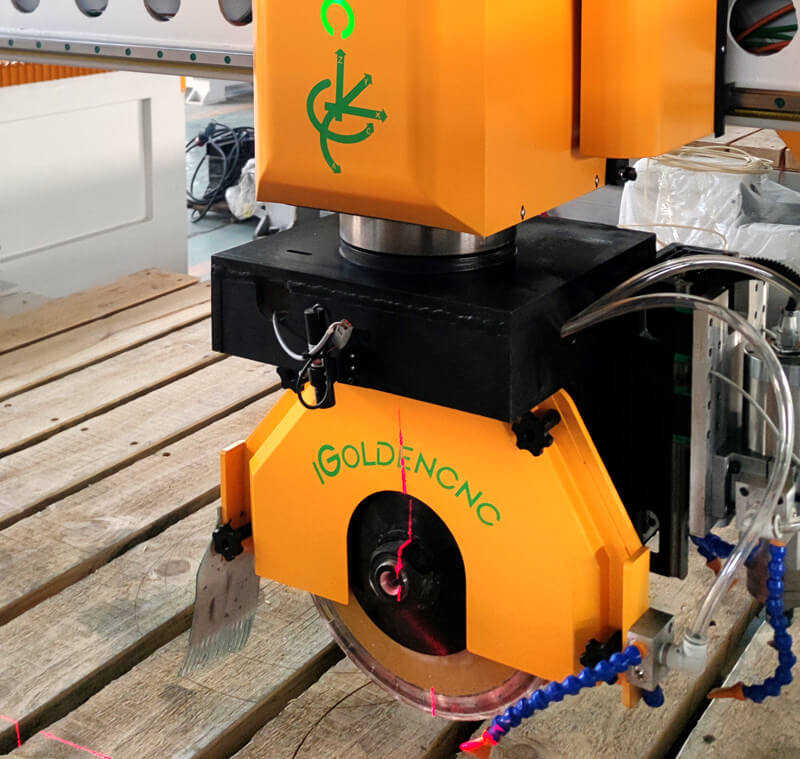
A CNC stone cutting bridge saw is a computer-controlled cutting machine that uses a diamond saw blade mounted on a bridge structure to process stone and ceramic materials.
The CNC controller controls the movement of the cutting head along the programmed cutting path.
Depending on the number of axes, the machine can perform:
- Straight cutting
- Cross cutting
- Diagonal cutting
- 45-degree miter cutting
- Stair tread cutting
- Floor tile cutting
- Countertop cutting
- Sink cutouts
- Curved cutting
- Internal cutouts
- Edge profiling
- Drilling and milling
4-axis and 5-axis bridge saws provide additional flexibility because the cutting head can rotate and tilt to produce angled and multidirectional cuts.

CNC Bridge Saw for Tile Cutting
One of the most important applications is tile cutting.
Traditional tile cutting methods are generally limited when manufacturers need large-format tiles, repeated dimensions, angled cuts, or customized shapes.
A CNC bridge saw provides a more automated approach.
It can cut stone and ceramic tiles into:
- Square tiles
- Rectangular tiles
- Diagonal tiles
- Border strips
- Customized shapes
- Large-format panels
The CNC system allows the operator to program the required dimensions instead of manually measuring and marking every tile.
For high-end flooring and architectural applications, this improves repeatability and production efficiency.
CNC Bridge Saw for Floor Tiles
Flooring projects often require hundreds or thousands of pieces with consistent dimensions.
A CNC bridge saw can be used to produce:
- Granite floor tiles
- Marble floor tiles
- Porcelain floor panels
- Ceramic floor tiles
- Custom stone paving
- Large-format floor panels
For projects involving different tile sizes, the operator can simply change the cutting program.
This is particularly useful for commercial flooring, hotels, shopping centers, villas, and large architectural projects.
Modern CNC bridge saw systems are used for dimensioned flooring tiles and large-format stone paving applications.
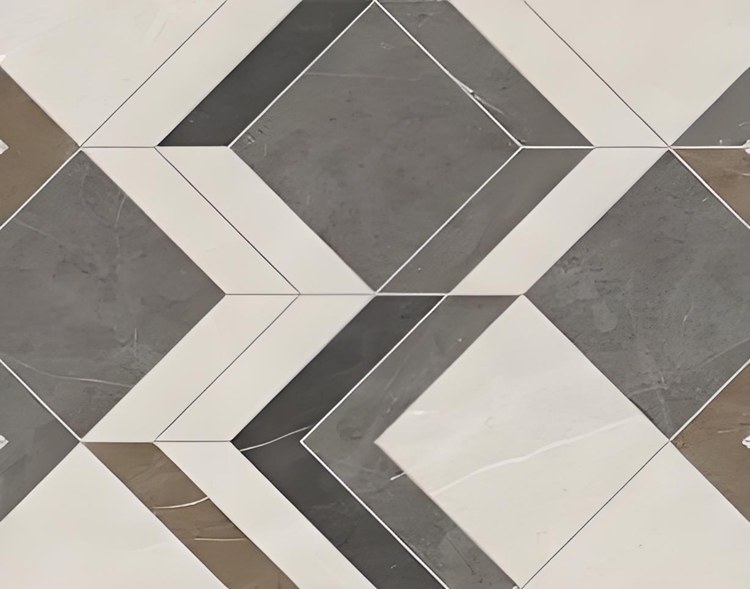
CNC Bridge Saw for Stone Stairs
Stone stair fabrication requires accurate dimensions and, in many cases, angled or beveled cuts.
A CNC bridge saw can process:
- Stair treads
- Stair risers
- Stringer components
- Landing slabs
- Stair nosing
- Decorative stair edges
A 5-axis bridge saw provides additional flexibility for complex stair fabrication because the blade can tilt and rotate.
Some 5-axis systems can also perform stair tread profiling and angled processing as part of an automated workflow.

Stair Tread Cutting
The machine can cut stone slabs into precisely dimensioned stair treads.
Stair Riser Cutting
The same machine can process vertical riser panels to match the stair design.
Edge and Miter Cutting
For premium staircases, the machine can produce:
- Beveled edges
- Chamfers
- Miter joints
- Decorative profiles
This helps create a more finished architectural appearance.
CNC Bridge Saw for Granite and Marble Flooring
Granite and marble flooring require accurate cutting because even small dimensional errors can affect installation.
A CNC bridge saw provides:
- Consistent dimensions
- Accurate positioning
- Repeatable cuts
- Programmable cutting paths
For large projects, the same digital cutting program can be reused for multiple pieces.
This reduces the need for repeated manual measurement.
CNC Bridge Saw for Kitchen Countertops
Although this article focuses on tile, stairs, and flooring, countertops are another major application for CNC bridge saws.
The machine can cut:
- Kitchen countertops
- Bathroom vanity tops
- Island countertops
- Bar tops
- Backsplashes
Advanced 4-axis and 5-axis models can also create sink and cooktop openings, mitered edges, and other customized shapes.
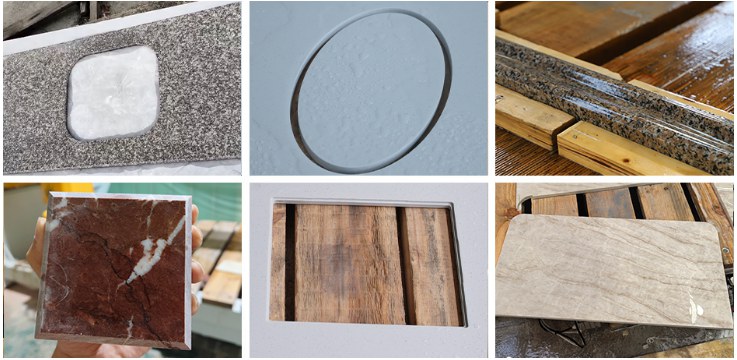
What Materials Can a CNC Bridge Saw Cut?
A CNC stone bridge saw can be configured for many hard materials.
Granite
Granite is widely used for:
- Kitchen countertops
- Staircases
- Floor tiles
- Wall cladding
- Vanity tops
- Outdoor paving
Marble
Marble is commonly processed into:
- Flooring
- Stair treads
- Wall panels
- Bathroom vanities
- Countertops
- Decorative architectural components
Quartz and Engineered Stone
CNC bridge saws can process engineered quartz slabs for:
- Kitchen countertops
- Bathroom vanity tops
- Bar counters
- Island countertops
Porcelain and Ceramic
Modern bridge saws can also process porcelain and ceramic slabs and tiles.
These materials are increasingly used for:
- Large-format flooring
- Wall panels
- Kitchen surfaces
- Bathroom surfaces
- Architectural decoration
Sintered Stone
Sintered stone is increasingly used in architectural and countertop applications. A suitable CNC bridge saw can provide precise cutting and mitering for these materials.
4-Axis CNC Stone Bridge Saw
A 4-axis CNC bridge saw provides more flexibility than a basic 3-axis cutting machine.
The additional rotary axis allows the cutting head to change orientation for different cutting requirements.
Typical applications include:
- Straight cutting
- Diagonal cutting
- 45-degree cutting
- Miter cutting
- Stair cutting
- Countertop fabrication
- Customized stone shapes
A 4-axis configuration can be a practical choice for stone fabrication companies that need more than simple straight cuts.
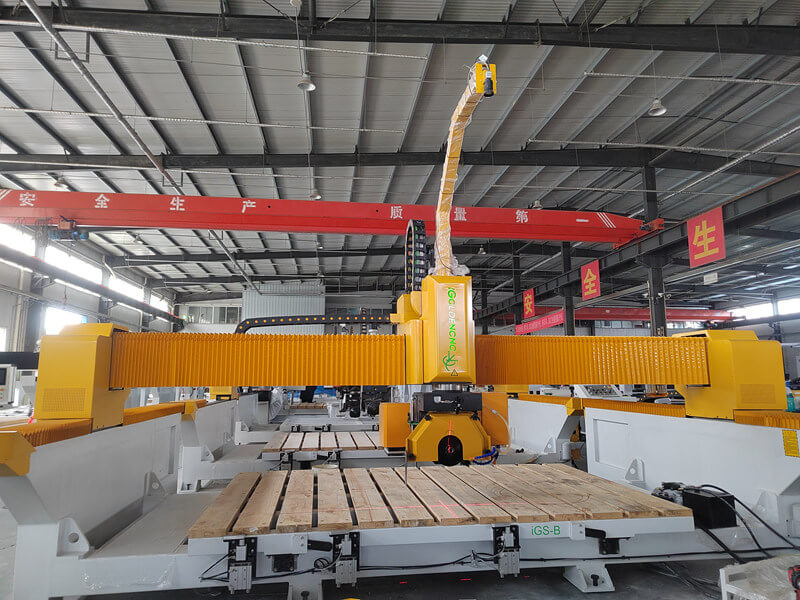
5-Axis CNC Stone Cutting Bridge Saw
A 5-axis CNC bridge saw provides even greater flexibility.
The cutting head can rotate and tilt to process complex shapes and angles.
Depending on the configuration, a 5-axis bridge saw can perform:
- Multidirectional cutting
- Miter cutting
- Curved cutting
- Internal cutouts
- Sink openings
- Stair fabrication
- Edge profiling
- Drilling
- Milling
5-axis CNC saws are increasingly used for complex stone fabrication because they reduce manual repositioning and allow more operations to be completed within one setup.
CNC Bridge Saw for Large-Format Porcelain and Tile
Large-format porcelain and ceramic slabs are becoming increasingly popular in modern architecture.
However, their large size makes manual cutting more difficult.
A CNC bridge saw provides:
- Stable slab positioning
- Programmable cutting
- Accurate dimensions
- Straight cuts
- Miter cuts
- Customized openings
For large-format flooring and wall applications, the machine can process large slabs into accurately sized architectural panels.
CNC Stone Bridge Saw for Floor and Wall Applications
The same CNC bridge saw can support both flooring and wall applications.
Floor Applications
- Marble flooring
- Granite flooring
- Porcelain flooring
- Ceramic tiles
- Stone paving
- Commercial floor panels
Wall Applications
- Marble wall panels
- Granite cladding
- Porcelain wall slabs
- Decorative stone panels
- Architectural facades
This makes the bridge saw a versatile machine for stone fabrication companies serving both residential and commercial construction projects.
How Does a CNC Stone Bridge Saw Work?
The basic workflow is:
Step 1: Load the Stone Slab
The marble, granite, quartz, porcelain, or ceramic slab is placed on the worktable.
Step 2: Create or Import the Design
The operator creates the cutting pattern using the CNC system or imports a compatible CAD/CAM file.
Step 3: Position the Cutting Head
The CNC system automatically moves the bridge and cutting head to the required position.
Step 4: Select the Cutting Parameters
The operator sets suitable:
- Cutting speed
- Blade parameters
- Cutting depth
- Cutting angle
Step 5: CNC Cutting
The diamond blade cuts along the programmed path.
Water cooling is commonly used during stone cutting to control heat and improve cutting conditions.
Step 6: Complete Additional Operations
Depending on the machine, additional operations such as drilling, milling, mitering, or edge profiling can be performed.
Step 7: Remove Finished Parts
The finished stone or tile components are ready for further processing or installation.
Main Features of a CNC Stone Cutting Bridge Saw
CNC Control System
The CNC controller manages the machine’s movement and cutting path.
This allows operators to repeat complex cutting programs with consistent results.
Diamond Saw Blade
A diamond blade is used for cutting hard materials such as:
- Granite
- Marble
- Quartz
- Porcelain
- Ceramic
- Sintered stone
Multi-Axis Cutting Head
Depending on the model, the cutting head can rotate and tilt to perform angled and multidirectional cuts.
Tilting Worktable
A tilting table can make loading large slabs easier and support certain angled processing requirements. Some industrial bridge saws use powered tilting tables with substantial load capacity.
Water Cooling System
Water is used during cutting to help control heat and manage stone cutting conditions.
Laser or Infrared Positioning
Some bridge saws use laser or infrared positioning to help operators align the material and cutting path accurately.
CNC Bridge Saw vs Traditional Stone Cutting Machine
| Feature | CNC Bridge Saw | Traditional Stone Saw |
|---|---|---|
| CNC Control | Yes | Limited/No |
| Automatic Cutting | Yes | Limited |
| Complex Shapes | Excellent | Limited |
| Miter Cutting | Excellent | Configuration-dependent |
| Stair Cutting | Excellent | Limited |
| Tile Cutting | Excellent | Good |
| Repeatability | High | Operator-dependent |
| CAD/CAM Integration | Available | Limited |
| Multi-Axis Cutting | Available | Limited |
| Production Efficiency | High | Medium |
The main advantage of CNC technology is not simply cutting speed. It is the combination of precision, automation, repeatability, and flexibility.
What Can You Make With a CNC Stone Bridge Saw?
A CNC bridge saw can produce a wide range of stone and ceramic products:
- Floor tiles
- Wall tiles
- Stair treads
- Stair risers
- Granite countertops
- Marble countertops
- Quartz countertops
- Vanity tops
- Kitchen islands
- Sink cutouts
- Cooktop openings
- Shower panels
- Door thresholds
- Window sills
- Stone wall panels
- Architectural components
This versatility makes the bridge saw suitable for both stone fabrication shops and architectural stone manufacturers.
How to Choose a CNC Bridge Saw for Tile, Stair and Floor Cutting?
1. Determine Your Materials
First identify whether you mainly process:
- Granite
- Marble
- Quartz
- Porcelain
- Ceramic
- Sintered stone
Different materials may require different blade and cutting parameters.
2. Consider the Maximum Slab Size
Select a worktable and working range according to the largest slabs or tiles you normally process.
3. Choose 4-Axis or 5-Axis
For basic cutting, a simpler configuration may be sufficient.
For stairs, miter cuts, complex shapes, and multi-directional cutting, a 4-axis or 5-axis CNC bridge saw is generally more suitable.
4. Check Cutting Thickness
Maximum cutting thickness depends on the blade diameter, machine configuration, and material.
5. Consider Additional Functions
Depending on your production requirements, useful options may include:
- Automatic tool changing
- Drilling
- Milling
- Edge profiling
- Camera positioning
- Laser positioning
- Tilting worktable
- Vacuum lifting system
IGOLDEN BLOG
Thank you for visiting the iGOLDENCNC website. iGOLDENCNC is the professional supplier of CNC machinery application solution, within the business of producing and selling CNC machinery and accessories.