
Granite countertops are popular in kitchens, bathrooms, commercial spaces, and architectural projects because granite combines durability, natural beauty, and excellent heat resistance. However, cutting granite accurately requires the right equipment, diamond tooling, cooling system, and machining process.
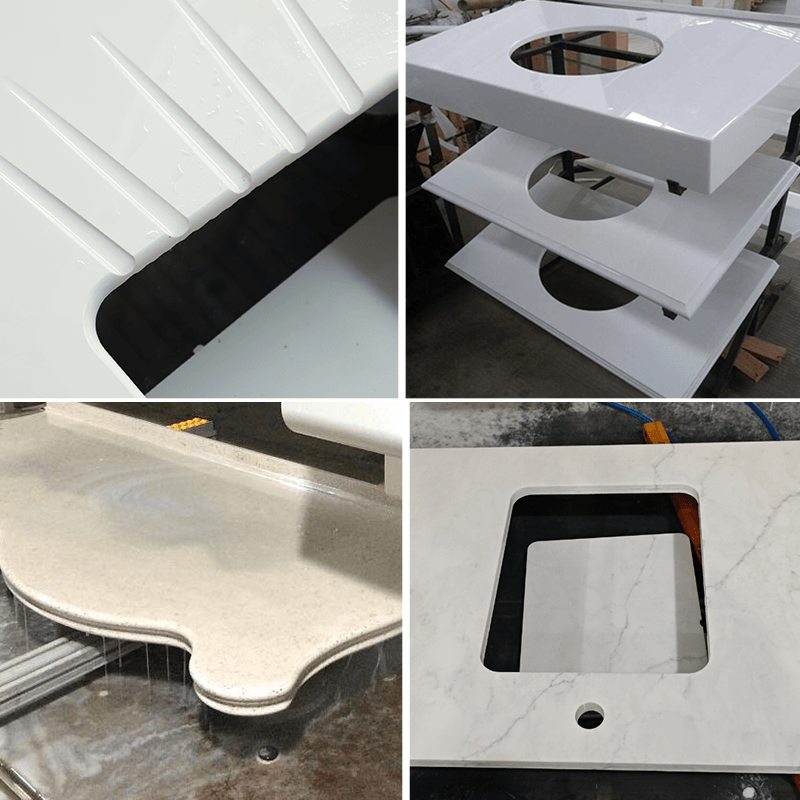
For professional stone fabricators, bridge saw machinery provides an efficient solution for cutting granite countertops with consistent dimensions and repeatable results.
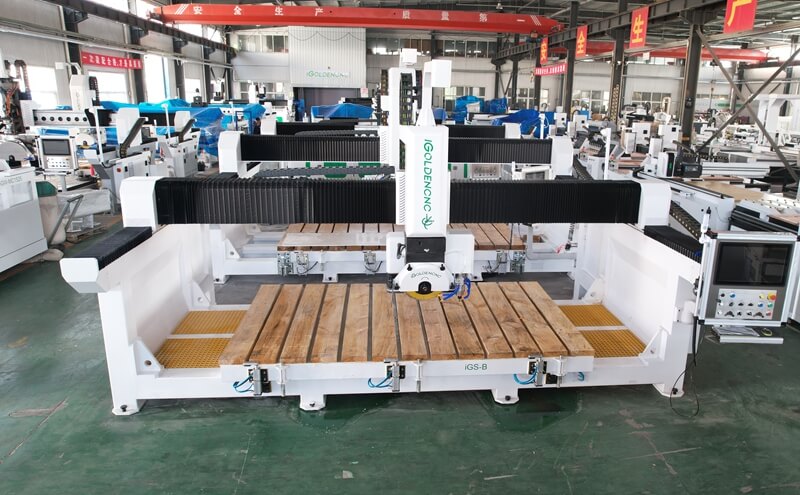
A modern CNC bridge saw for granite countertops can perform straight cuts, angled cuts, bevel cuts, miter cuts, sink openings, cooktop openings, and other customized stone-cutting operations. Advanced 5-axis systems can also provide greater flexibility for complex countertop fabrication.
This guide explains how to cut granite countertops with bridge saw machinery, how CNC technology improves granite fabrication, and how to choose the right bridge saw for your workshop.
What Is a Granite Countertop Bridge Saw?
A granite countertop bridge saw is a stone-cutting machine specifically designed to cut granite slabs into precise countertop components.
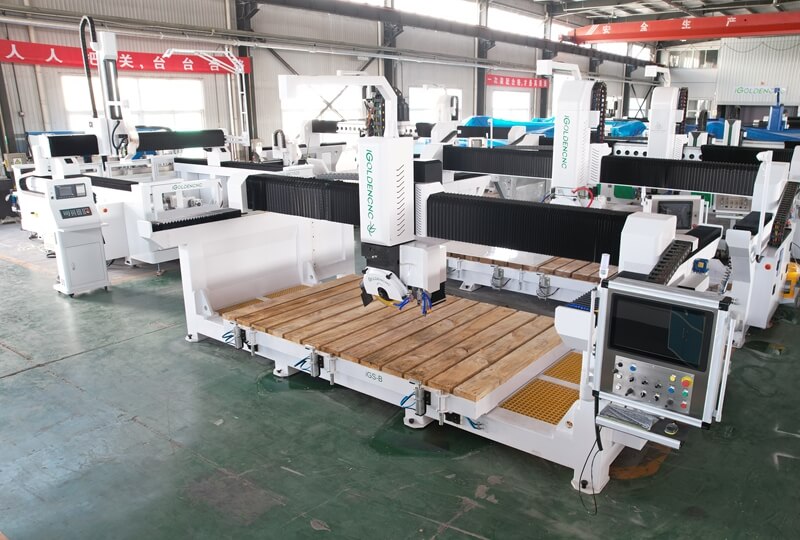
The machine normally consists of:
- Bridge frame
- CNC-controlled cutting head
- Diamond saw blade
- Cutting table
- Water cooling system
- CNC control system
- Linear guide system
- Drive motors
- Positioning system
The granite slab is placed securely on the worktable. The CNC system controls the movement of the cutting head according to the programmed cutting path.
Unlike manual cutting equipment, CNC bridge saw machinery can automatically repeat programmed cutting operations.
This makes it particularly useful for professional granite countertop fabrication.
Bridge Saw
A CNC bridge saw is a computer-controlled stone cutting machine designed to process slabs of granite, marble, quartz, quartzite, porcelain, ceramic, and other stone materials.
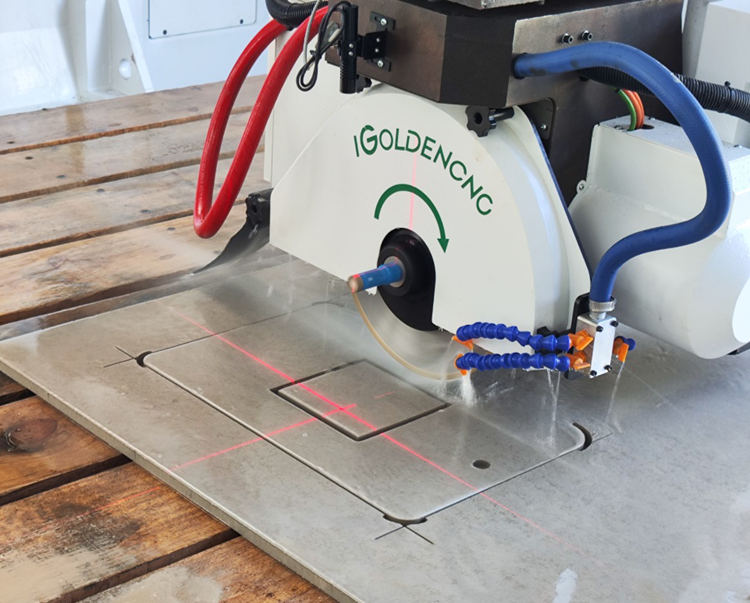
Compared with a traditional manual bridge saw, a CNC bridge saw can automatically control movements such as:
- X-axis movement
- Y-axis movement
- Z-axis movement
- Blade rotation
- Blade tilting
- Milling
- Drilling
- Profiling
- Sink cutouts
- Faucet holes
- Grooves
- Miter cuts
- Curved or complex cutting paths
Modern CNC bridge saws are widely used for:
- Kitchen countertops
- Bathroom countertops
- Vanity tops
- Stone islands
- Waterfall countertops
- Fireplace surrounds
- Monument fabrication
- Flooring and architectural stone
- Quartz and porcelain panels
- Custom stone projects
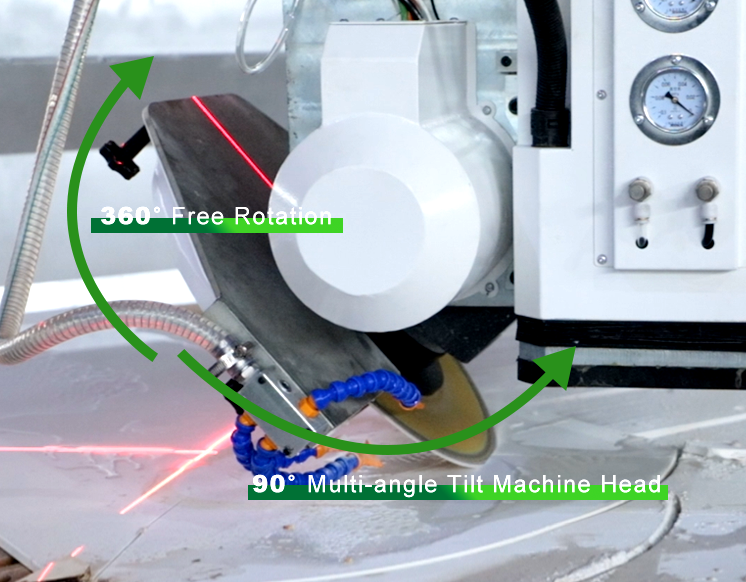
The difference between 4-axis and 5-axis machines becomes especially important when a fabricator needs 45-degree miter cuts, angled cuts, curved shapes, sink openings, or integrated CNC machining.

Why Use Bridge Saw Machinery for Cutting Granite Countertops?
Granite is a hard natural stone, so accurate cutting requires a machine capable of maintaining stable blade movement and sufficient cutting power.
A professional bridge saw provides several advantages.

High Cutting Accuracy
CNC positioning allows the cutting head to follow programmed dimensions accurately.
This is important when fabricating countertops that need to fit:
- Kitchen cabinets
- Islands
- Sinks
- Cooktops
- Walls
- Appliances
Consistent Production
Once the cutting program has been created, the machine can repeat similar operations with consistent results.
Complex Cutting
Depending on the machine configuration, CNC bridge saws can perform:
- Straight cuts
- L-shaped cuts
- Angled cuts
- Bevel cuts
- Miter cuts
- Sink cutouts
- Cooktop openings
- Faucet holes
Reduced Manual Labor
Automation reduces the amount of manual measuring, positioning, and cutting required during production.
Water-Cooled Cutting
Water is commonly used during stone sawing to cool the blade, control dust, and help manage heat generated during cutting.
Cutting Granite Countertops for Sink Openings
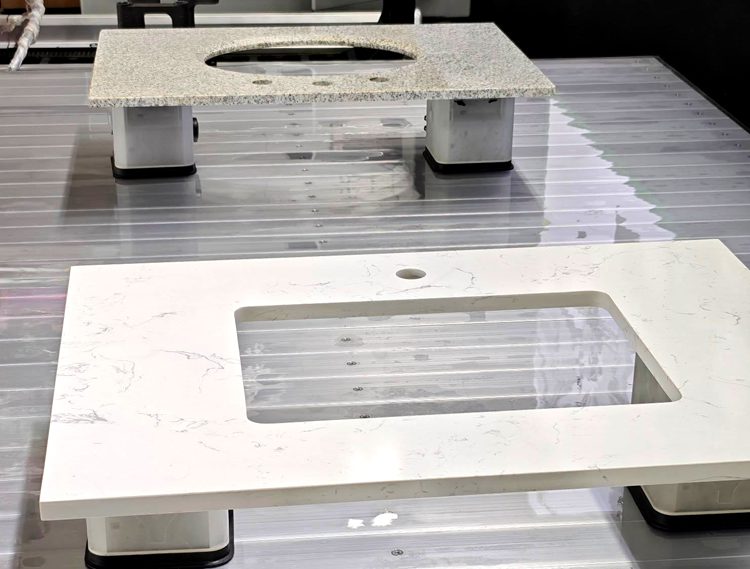
One of the most common countertop fabrication operations is creating a sink cutout.
Depending on the bridge saw configuration, sink openings may be produced through sawing, milling, or a combination of processes.
Common countertop openings include:
- Undermount sink
- Top-mount sink
- Farmhouse sink
- Bar sink
- Cooktop opening
A CNC system can help maintain consistent dimensions and corner geometry.
For integrated countertop machining, some bridge saw configurations include additional milling or drilling capabilities.
Cutting Granite Countertops for Faucet Holes
Granite countertops often require holes for:
- Faucets
- Soap dispensers
- Water filtration systems
- Accessories
Drilling granite requires appropriate diamond tooling.
A CNC stone machining system with drilling capability can automate hole positioning and improve repeatability.
The exact tool and drilling parameters depend on the granite type, hole diameter, thickness, and machine configuration.
Cutting 45-Degree Mitered Granite Countertops
45-degree miter cutting is commonly used for premium countertop fabrication.
Mitered granite edges can create the appearance of a thicker countertop and are frequently used for:
- Waterfall countertops
- Kitchen islands
- Peninsula countertops
- Decorative edges
- Architectural stone
A 5-axis CNC bridge saw provides greater flexibility for miter cutting because the cutting head can be positioned at different angles.
This is one reason why 5-axis bridge saws are increasingly attractive for advanced countertop fabrication.
Granite Waterfall Countertops
A waterfall countertop extends the countertop material vertically down the side of an island.
Producing a high-quality waterfall edge usually requires precise miter cutting.
The fabricator needs to ensure that:
- Both pieces have accurate dimensions
- The miter angles are correct
- The edges align properly
- The stone pattern is visually matched
- The joint is clean
A CNC bridge saw can help automate the cutting process and improve repeatability.
For complex waterfall countertop production, a 5-axis CNC bridge saw can provide additional angular flexibility compared with basic bridge saw configurations.
How to Choose a Granite Countertop Bridge Saw
Before purchasing a bridge saw, consider the following factors.
1. Maximum Cutting Size
Check the machine’s:
- Working length
- Working width
- Cutting thickness
- Blade diameter
The machine should accommodate your typical granite slab dimensions.
2. Machine Power
The required power depends on:
- Granite hardness
- Blade size
- Cutting depth
- Production volume
- Desired cutting speed
3. Axis Configuration
Choose according to your applications:
4-axis: Standard cutting
4+1-axis: Cutting plus additional machining
5-axis: Advanced miter and multi-angle cutting
5+1-axis: Advanced cutting plus additional machining
5+2-axis: Highly integrated processing, depending on the manufacturer’s configuration

4. CNC Software
A user-friendly control system can simplify:
- Program creation
- Cutting path management
- Machine operation
- Job storage
- Repeat production
5. Water Cooling
Wet cutting is commonly used for granite processing. Make sure the machine has an appropriate water supply, circulation, and collection system.
6. After-Sales Support
For industrial equipment, consider:
- Installation
- Operator training
- Remote technical support
- Spare parts
- Maintenance
- Warranty

Conclusion
Cutting granite countertops with bridge saw machinery provides professional stone fabricators with a precise and repeatable method for processing granite slabs.
A CNC bridge saw can help automate:
- Straight slab cutting
- Angled cutting
- Miter cutting
- Sink openings
- Cooktop openings
- Faucet holes
- Custom countertop shapes
For basic granite countertop fabrication, a 4-axis bridge saw can provide an effective balance of performance and cost.
For manufacturers producing waterfall countertops, mitered edges, complex shapes, and advanced architectural stone components, a 5-axis CNC bridge saw can provide greater cutting flexibility.
If integrated machining is also required, 4+1, 5+1, or 5+2 axis bridge saw configurations may provide additional capabilities depending on the specific machine architecture.
The key is to choose a bridge saw based not only on the number of axes, but also on cutting capacity, spindle power, blade size, CNC software, machining functions, automation, tooling, and your actual granite countertop production workflow.
A properly selected CNC bridge saw can become the foundation of an efficient digital stone fabrication operation, helping manufacturers improve cutting consistency, reduce manual work, optimize granite slab utilization, and expand their countertop production capabilities.
IGOLDEN BLOG
Thank you for visiting the iGOLDENCNC website. iGOLDENCNC is the professional supplier of CNC machinery application solution, within the business of producing and selling CNC machinery and accessories.