
A bridge saw is a large industrial cutting machine used primarily in the stone processing industry to cut materials such as granite, marble, quartz, and engineered stone slabs. The machine gets its name from the bridge-like structure that spans across the cutting table and supports the motor and circular saw blade.
Bridge saws are commonly used in stone fabrication shops, countertop manufacturing factories, and monument processing plants because they provide high-precision cutting for heavy stone slabs.
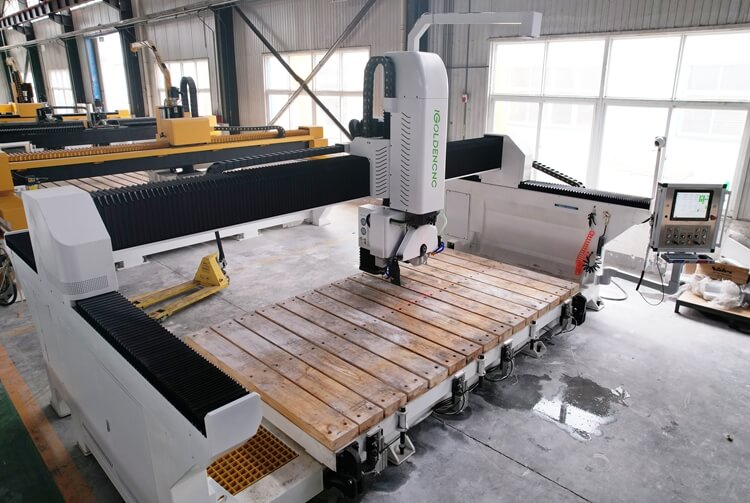
Understanding Bridge Saws
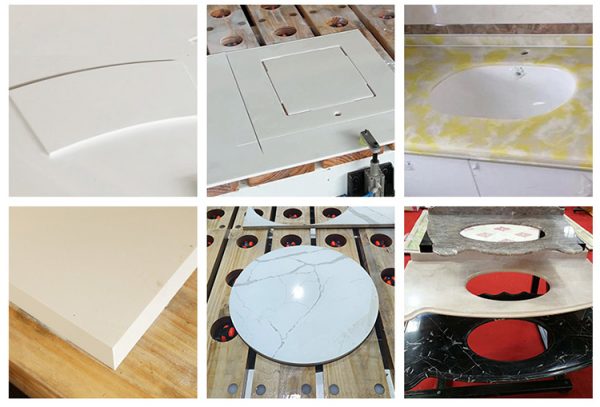
The era of automation in stone fabrication has arrived. Just design the shape you want, and a CNC bridge saw can automatically create personalized sink cutouts in granite, marble, and quartz countertops in minutes.
An automatic bridge saw can match almost every need for custom countertop cutouts for sinks and stoves with stone, and make the process with ease.
Whether you are a professional kitchen customizer, and have to create personalized sink cutouts or stove cutouts for countertops, or you are in the bathroom vanity customization business, and need to make a variety of unique vanity tops, a CNC bridge saw is a great partner for stone cutouts with a seamless look. All you need to do is provide your individual drawings and dimensions for countertop cutouts.

Understanding CNC Axis Configurations in Stone Bridge Saws
Of all the decisions a stone fabrication business faces when investing in CNC cutting technology, few generate more confusion — or more costly errors — than the question of axis configuration. Walk into any stone machinery trade show and you will hear the terms 4-axis, 4+1, 5-axis, and 5+1 used interchangeably by salespeople, misunderstood by buyers, and defined inconsistently across manufacturers. The result is that fabricators routinely purchase machines with either more capability than their work justifies — paying for complexity they never use — or less capability than their product mix demands, discovering the gap only after the machine is installed and production has begun.
This guide exists to eliminate that confusion. By the time you finish reading, you will understand precisely what each axis configuration means mechanically, what cut operations each one enables and cannot perform, what each configuration costs to buy and operate, and — most importantly — how to match the right configuration to the specific demands of your fabrication business.
The right axis configuration is not the most advanced one available. It is the one that fits your product mix, your production volume, your operator skill level, and your capital budget — and then grows with you as your business evolves.
The X axis is the primary linear axis — the direction in which the bridge beam travels along the length of the cutting table, moving the entire bridge assembly from one end of the table to the other. The Y axis is the secondary linear axis — the direction in which the cutting head traverses along the bridge beam, moving from one side of the table to the other. The Z axis is the vertical axis — the up-and-down movement of the cutting head that controls cut depth and raises the blade clear of the material between cuts. The A axis is the tilting axis — rotation of the cutting head around the Y axis, which tilts the blade from vertical (0°) to horizontal (90°) and the angles in between, enabling miter cuts. The C axis is the rotation axis — rotation of the cutting head around the Z axis (the vertical axis), which rotates the entire cutting assembly in the horizontal plane, allowing the blade to point in any compass direction relative to the table.
The “+1” designation — as in 4+1 or 5+1 — refers to an additional axis that can be positioned independently but does not participate in simultaneous interpolation with the other axes during cutting. In practical terms, a “+1” axis is an indexed axis: the machine moves it to a pre-set position, locks it there, and then executes the cut using the remaining axes. It cannot move dynamically during the cut itself. This distinction — between a fully interpolated axis and an indexed positioning axis — is the single most important technical concept in understanding the capability differences between axis configurations.
What Is a 4-Axis Bridge Saw?
A 4-axis bridge saw controls X, Y, Z, and A — the three linear axes plus the blade tilt axis. All four axes can operate simultaneously during cutting, meaning the machine can move the cutting head in any combination of horizontal, vertical, and tilting motion while the blade is engaged in the material.
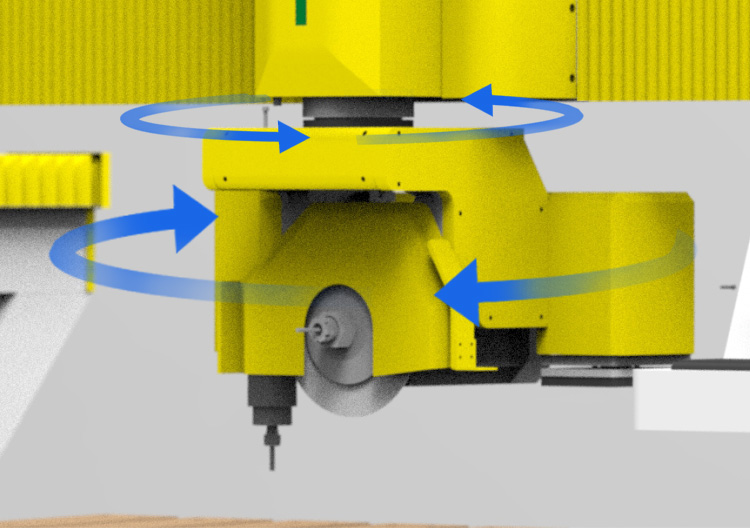
What a 4-Axis Machine Can Do
A 4-axis bridge saw handles the vast majority of operations in a standard countertop fabrication shop.
It cuts slabs to dimension with straight parallel cuts along X or Y. It makes plunge cuts to any depth by controlling Z.
It tilts the blade to any angle from 0° to 45° (and sometimes 90° on machines with extended A axis range) for miter cuts along either the X or Y axis direction. For a shop producing standard kitchen and bathroom countertops — rectangular pieces with straight edges, sink cutouts, and 45° miter edges — a 4-axis machine handles virtually every job that comes through the door.
What a 4-Axis Machine Cannot Do
The fundamental limitation of a 4-axis bridge saw is that the cutting blade always points in the same direction relative to the bridge beam — it can tilt toward or away from the operator, but it cannot rotate in the horizontal plane. This means the machine cannot make diagonal cuts across the slab without repositioning the workpiece. It cannot follow a curved cut path. It cannot make compound miter cuts where the blade is simultaneously tilted and rotated. Any job requiring a diagonal cut line that is neither parallel nor perpendicular to the bridge beam direction requires either manual workpiece repositioning — consuming setup time and introducing alignment error risk — or an entirely different machine.
Who Should Choose a 4-Axis Bridge Saw
A 4-axis bridge saw is the right choice for fabrication shops whose work consists primarily of standard rectangular countertops, straight-cut tile sizing, and conventional 45° miter edges. It delivers excellent accuracy and productivity for this work at a capital cost significantly below 5-axis machines. If your shop produces fewer than 5–10% of jobs requiring diagonal cuts or curved profiles, the productivity and quality gains from upgrading to a higher axis configuration will not justify the additional investment.
Price Range: $12,000–$15,000 depending on table size, motor power, and brand.
What Is a 4+1 Axis Bridge Saw?
A 4+1 axis bridge saw controls X, Y, Z, and A as fully interpolated cutting axes — identical to a standard 4-axis machine — and adds a C axis that can be indexed to preset angular positions but does not participate in simultaneous motion with the other axes during cutting.
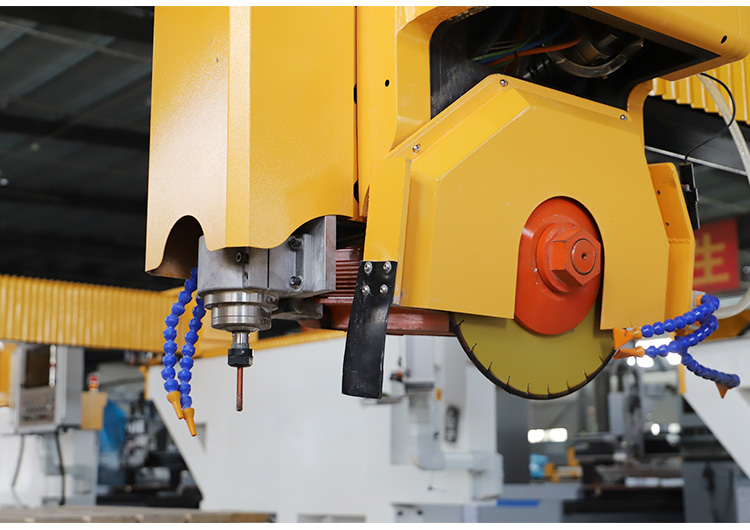
What the “+1” C Axis Adds
The indexed C axis of a 4+1 machine allows the cutting head to be rotated to a specified angular position — say, 30°, 45°, or 60° relative to the bridge direction — locked there, and then used to make straight cuts at that angle across the slab without repositioning the workpiece. This is a genuinely useful capability for fabricators who regularly need to cut diagonal lines at fixed angles: cutting parallelogram-shaped pieces, making angled end cuts on countertop sections, or producing consistently angled architectural elements.
The key distinction from a true 5-axis machine is that the C axis cannot move while cutting is in progress. The machine must stop, rotate the head to the new angle, lock it, and then resume cutting. This means the 4+1 machine cannot follow a smoothly curved cut path — it can only approximate a curve through a series of short straight-line segments at progressively changing angles, with a stop-and-reposition between each segment. For most practical diagonal cutting applications, this limitation is irrelevant. For curved cutting, it is a fundamental constraint.
The Practical Productivity Gain
The elimination of workpiece repositioning for diagonal cuts is the primary value of the 4+1 configuration over a standard 4-axis machine. Repositioning a large granite slab to make a diagonal cut — realigning it on the table, re-establishing reference points, and verifying the new orientation — can take 15–30 minutes per operation. On a busy shop floor producing multiple angled pieces per shift, the indexed C axis pays for itself in recovered setup time relatively quickly.
Who Should Choose a 4+1 Axis Bridge Saw
A 4+1 bridge saw is appropriate for fabrication shops that regularly produce work requiring diagonal cuts at fixed angles — parallelogram countertop sections, angled end splashes, consistently angled architectural pieces — but do not produce curved stone profiles or compound angle cuts that require simultaneous C axis motion. It occupies a practical middle ground between the simplicity of a 4-axis machine and the full capability of a true 5-axis system, at a corresponding intermediate price point.
Price Range: $15,000–$220,000 depending on configuration and manufacturer.
What Is a 5-Axis Bridge Saw?
A 5-axis bridge saw controls all five axes — X, Y, Z, A, and C — simultaneously. All five axes can move in fully coordinated interpolation during a single cut, meaning the machine can follow a curved path across the slab, change blade angle continuously while moving, and produce compound bevel profiles that require the simultaneous coordination of tilting and rotating motion.

What True Simultaneous 5-Axis Interpolation Enables
The defining capability of a true 5-axis bridge saw — the one that separates it fundamentally from both 4-axis and 4+1 machines — is the ability to follow a curved cutting path with the blade continuously moving and continuously changing orientation. The C axis does not stop and reindex between positions; it rotates smoothly while the X and Y axes move simultaneously, producing a genuinely curved kerf through the stone.
This capability unlocks cut geometries that are otherwise impossible with a rotating blade: curved countertop fronts that follow the contour of a kitchen island, radius cuts for rounded stone table edges, sweeping curved cladding panels for curved architectural walls, circular cutouts without requiring a core drill, and compound miter profiles where the blade is simultaneously tilted and rotating along a curved path.
Beyond curved cutting, the true 5-axis machine also handles all the applications of the 4+1 machine — diagonal cuts at any angle without workpiece repositioning — but executes them with greater speed and flexibility because the C axis responds dynamically rather than requiring a stop-and-lock sequence.
The Tool Change Advantage
Many 5-axis bridge saws include automatic tool changers that allow the machine to switch between a circular cutting blade, a core drill bit, a profile grinding wheel, and a polishing pad within a single program, driven by the same 5-axis CNC controller. This integration — made practical by the full axis control that allows the machine to approach the workpiece from any direction with any tool — effectively combines the functions of a bridge saw, a CNC router, and an edge profiler in a single machine for many operations.
Who Should Choose a 5-Axis Bridge Saw
A 5-axis bridge saw is the right choice for fabrication shops that produce a meaningful volume of curved stone profiles, complex architectural stonework, high-end custom residential installations with non-rectangular countertop shapes, or any work where compound angle cuts are a regular production requirement. It is also the appropriate choice for shops that want a single machine capable of handling virtually any cut geometry a customer or architect can specify — future-proofing their cutting capability against evolving market demands.
Price Range: $25,000–$30,000 depending on table size, motor power, tool changer configuration, and manufacturer.
What Is a 5+1 Axis Bridge Saw?
A 5+1 axis bridge saw represents the most capable configuration currently available in production stone cutting machinery. It combines true simultaneous 5-axis interpolation across X, Y, Z, A, and C with a sixth axis — typically a B axis (rotation of the cutting head around the X axis, or a secondary tilting direction) or a motorized rotary table that allows the workpiece itself to be repositioned under CNC control.
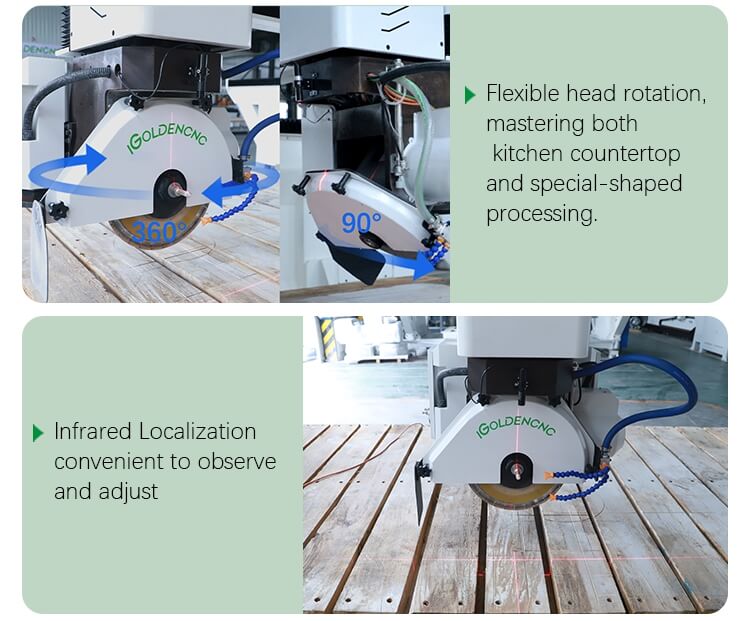
What the Sixth Axis Adds
The sixth axis in a 5+1 configuration provides an additional degree of freedom that enables cut geometries and surface approaches impossible even with full 5-axis interpolation. A B axis — secondary tilt perpendicular to the primary A axis tilt — allows the blade to be inclined in two independent tilting directions simultaneously, enabling truly arbitrary blade orientation in three-dimensional space. This capability is used for complex sculptural stone elements, custom fountain components, three-dimensional carved surfaces, and precision architectural details where the cut surface must be oriented at a compound angle that cannot be expressed as a combination of A and C axis motion alone.
A motorized rotary workpiece table — the most common form of the sixth axis in production bridge saw configurations — allows the machine to rotate the stone piece under CNC control and present different faces to the cutting head without manual handling. This is particularly valuable for processing thick stone blocks into multiple-face finished elements, cutting stone furniture components, and producing complex 3D stone objects where cuts must be made on multiple faces in precise angular relationship to each other.
The Practical Reality of 5+1 in Production
It is important to be clear that the full capability of a 5+1 axis bridge saw is required by a relatively small subset of stone fabrication work — primarily high-end sculptural and architectural stonework, custom stone furniture, precision monument work, and specialized industrial stone components. For the overwhelming majority of countertop fabrication, tile production, and standard architectural cladding work, a true 5-axis machine provides all the capability needed and the sixth axis adds cost without adding practical value.
The 5+1 configuration is the right investment for shops that have specifically identified a market opportunity in complex 3D stonework and have the technical team, the software infrastructure, and the customer relationships to utilize the additional capability productively.
Price Range: $25,000–$30,000+ depending on sixth axis type, table size, and full system configuration.
Main Components of a Bridge Saw
1. Bridge Structure
The bridge is the horizontal beam that moves across the machine frame and supports the cutting head.
2. Cutting Blade
Bridge saws use diamond circular blades, which are strong enough to cut very hard materials such as granite and quartz.
3. Work Table
The work table supports the stone slab being cut. Some tables can tilt or rotate to make angled cuts easier.
4. Motor
A powerful motor drives the blade rotation, typically ranging from 7.5 kW to 22 kW depending on the machine size.
5. Water Cooling System
Water is pumped onto the blade during cutting to cool it and reduce dust.
Side-by-Side Comparison: Capabilities, Limitations & Cost
| Feature | 4-Axis | 4+1 Axis | 5-Axis | 5+1 Axis |
|---|---|---|---|---|
| Straight cuts (X/Y) | ✓ | ✓ | ✓ | ✓ |
| Miter cuts (A axis tilt) | ✓ | ✓ | ✓ | ✓ |
| Diagonal cuts (fixed angle) | Manual reposition | ✓ Indexed C | ✓ Dynamic C | ✓ Dynamic C |
| Diagonal cuts (any angle, no reposition) | ✗ | ✓ | ✓ | ✓ |
| Curved cutting paths | ✗ | Approximated only | ✓ True curve | ✓ True curve |
| Compound miter + rotation simultaneously | ✗ | ✗ | ✓ | ✓ |
| Multi-face workpiece cuts (CNC) | ✗ | ✗ | ✗ | ✓ |
| 3D sculptural profiles | ✗ | ✗ | Limited | ✓ |
| Typical price range | $12K–$15K | $15K–$20K | $20K–$25K | $25K–$30K+ |
| Programming complexity | Low | Medium | High | Very High |
| Operator skill required | Basic | Intermediate | Advanced | Expert |
| Best application | Standard countertops | Mixed straight + diagonal | Custom + architectural | Sculptural + 3D stone |
Real-World Application Guide by Product Type
Matching axis configuration to specific product types removes the abstraction from the decision and grounds it in the practical reality of your production floor.
Standard Kitchen & Bathroom Countertops
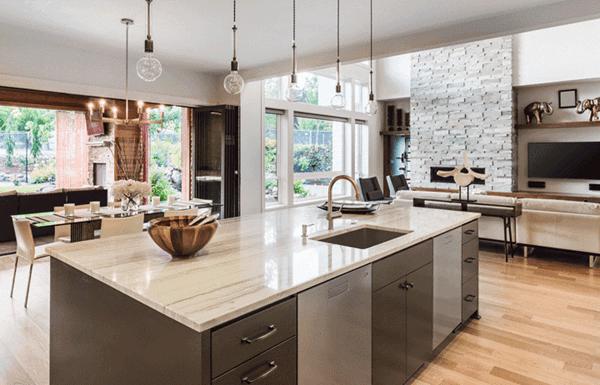
The overwhelming majority of standard countertop work — rectangular slabs cut to dimension, sink and cooktop cutouts, straight backsplash pieces, and 45° miter edges — is handled completely and efficiently by a 4-axis bridge saw. The A axis tilt provides all the miter capability needed for standard edge profiles. There is no curved cutting, no diagonal cut requirement, and no compound angle demand in this work. A 4-axis machine is the optimally economic choice for shops whose work consists primarily of this category.
Waterfall Edge Countertops
Waterfall countertops — where the stone surface continues vertically down the side of an island or cabinet, requiring a precisely matched 45° miter joint at the top corner — require accurate A axis tilting and precise Z axis depth control but no C axis rotation. A 4-axis machine handles waterfall edges completely. The commonly repeated claim that waterfall countertops require a 5-axis machine is incorrect for the standard straight waterfall design.
Curved Countertop Fronts & Radius Edges
Countertops with curved front edges — following the contour of a curved kitchen island or a semicircular bar top — require the blade to follow a curved path across the slab surface. This is where the distinction between 4+1 and true 5-axis becomes critical. A 4+1 machine can approximate a gentle curve through a series of short indexed straight cuts, but the resulting edge will show faceting — a series of small flat sections rather than a smooth curve — that requires significant hand grinding to finish. A true 5-axis machine follows the curve continuously and produces a smooth curved kerf that requires minimal finishing. For curved countertop production at any meaningful volume, a true 5-axis machine is the appropriate investment.
Staircase Components — Treads, Risers & Curved Staircases
Straight staircase treads with standard nosing profiles are handled by a 4-axis machine with edge profiling capability. Curved staircase treads — cut to follow the radius of a curved staircase plan — require true 5-axis capability for efficient production. The curved cut on each tread is unique to its position in the staircase, making manual repositioning impractical at production scale. A 5-axis machine programs each curved tread from its DXF template and cuts it in a single uninterrupted operation.
Architectural Cladding Panels
Standard rectangular cladding panels are efficiently produced on a 4-axis machine. Cladding panels cut to follow a curved building facade, or panels with angled edges for corner junctions at non-standard angles, require either 4+1 (for fixed-angle junctions) or 5-axis (for curved facade panels) capability. For large architectural projects specifying complex cladding geometries, 5-axis capability is often the difference between winning the work and being unable to quote it competitively.
Decorative Inlays, Medallions & Mosaic Work
Decorative stonework involving complex geometric inlays, circular medallions, and intricate mosaic patterns requires cutting shapes with tight curves, acute angles, and precise fit between adjacent pieces. A 5-axis bridge saw can produce many of these shapes, but a waterjet cutter is typically faster, more precise, and better suited to very intricate patterns and tight internal radii. For dedicated inlay and mosaic production, a waterjet cutter is a more appropriate primary investment than a 5-axis bridge saw — though the combination of both offers the broadest capability.
Custom Stone Furniture & Sculptural Elements
Three-dimensional stone objects — tables, benches, sculptural installations, custom fountain components — require multi-face cutting and surface approaches that go beyond what even a true 5-axis bridge saw can achieve efficiently. This is where the 5+1 configuration with a rotary workpiece table genuinely earns its investment: the ability to present multiple faces of a stone object to the cutting head under CNC control, maintaining precise angular relationships between cuts on different faces, is the capability that makes complex 3D stonework achievable at production scale.
Final Thoughts
The decision between a 4-axis, 4+1, 5-axis, and 5+1 stone bridge cutting saw is one of the most consequential capital allocation decisions a fabrication business makes — not because any configuration is inherently superior, but because each one fits a specific business profile, and the cost of a mismatch compounds over the 10–15 year life of the machine.
The framework for making this decision correctly is straightforward, even if applying it requires discipline. Audit your current product mix honestly. Identify the cut types your business actually produces and the percentage of revenue each represents. Build a realistic — not aspirational — projection of how that mix will evolve over the next five years. Calculate the revenue premium that additional axis capability would enable, and compare it against the full cost differential including software, training, and maintenance. Then choose the configuration whose economics make sense for your specific business — not the one that sounds most impressive in a sales presentation.
IGOLDEN BLOG
Thank you for visiting the iGOLDENCNC website. iGOLDENCNC is the professional supplier of CNC machinery application solution, within the business of producing and selling CNC machinery and accessories.