
Automatic CNC Nesting Machine with Robotic Loading
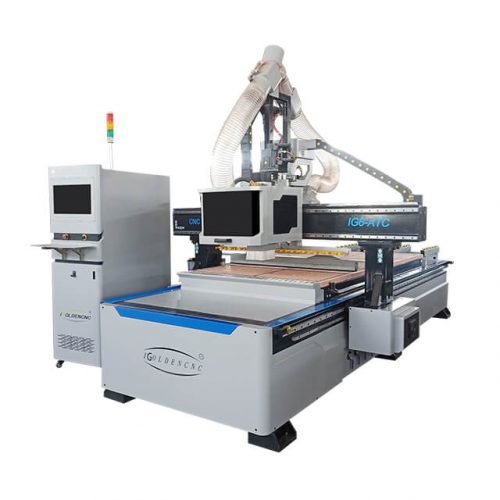
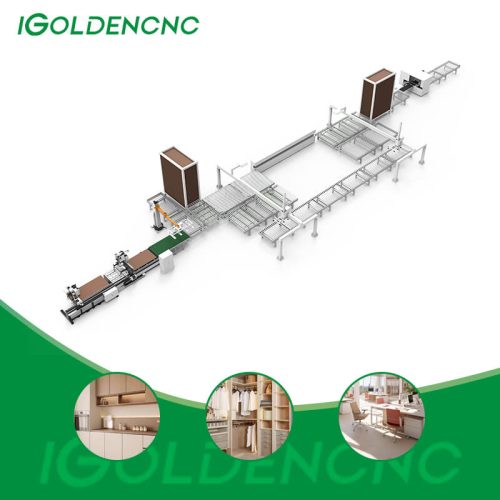
An automatic CNC nesting machine with robotic loading is a panel furniture processing system that integrates an industrial robotic arm with a CNC nesting router and an automatic labeling unit.


CNC Nesting Machine with Robotic Loading and Panel Labeling System
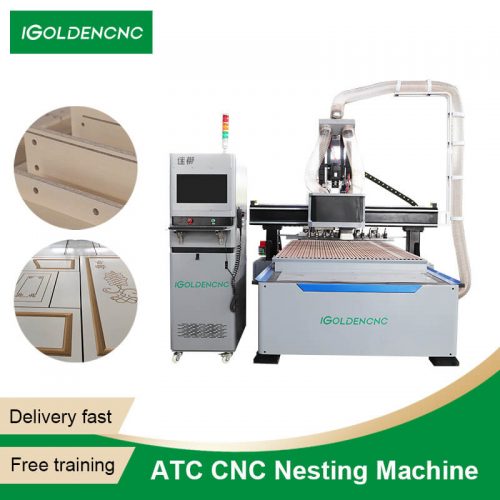
This is a panel furniture nesting cell, not a standalone router. A robotic loading system feeds boards onto the gantry table, the labeling unit prints and applies a part label before the first cut, the ATC spindle then performs nesting cuts, drilling and grooving in a single clamping, and the finished parts leave the table labeled, identified and ready for edge banding.
The result is a production line that runs on a program instead of a crew. One operator supervises the cell, the machine keeps cutting through the shift, and every panel reaching the edge bander carries the label that tells the operator where it belongs.
Built for cabinet, wardrobe and office furniture plants running mixed, high-variety panel batches where manual marking and sorting — not cutting speed — is the real bottleneck.
ATC Nesting CNC Machine with Labeling Function Video

Equipment Introduction


Key Features
1. Robotic Loading System
The loading unit takes boards from the stack, aligns them to the table reference and releases them to the vacuum zones without manual lifting. Stack height, cycle interval and panel thickness are set in the program, so one batch can alternate between different board types without re-setting the machine by hand.
2. Panel Labeling Before the First Cut
The labeling head prints and applies the part label while the board is still whole and stationary — the most reliable moment in the cycle. Labels carry part ID, barcode or QR, material, size and edge-banding direction. Because the label is applied before nesting, every downstream part inherits it automatically; no operator has to mark or match panels after cutting.
3. Heavy-Duty Gantry Structure
The bridge is a welded, stress-relieved steel gantry running on both side rails, which keeps the spindle square to the table across the full working width. Cutting force is carried by the frame rather than the beam, so deep cuts in dense MDF do not translate into chatter or tapered edges.
4. Automatic Tool Changer (ATC)
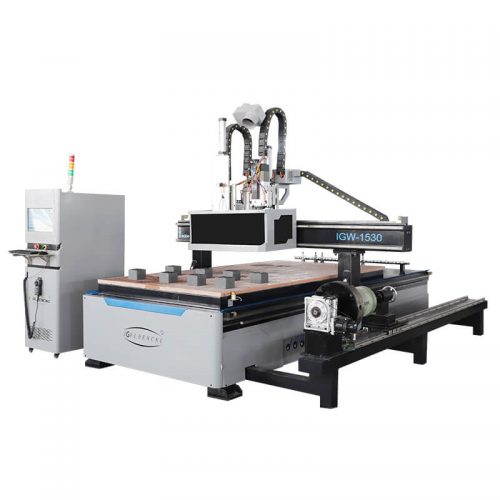
A multi-position tool magazine lets the program switch between nesting cutter, drill bits and grooving tools within the same cycle. One clamping, one program, no manual bit changes between operations — which is what makes single-pass drilling and grooving practical on a nesting cell.
5. Nesting Optimization Workflow
The control accepts part lists and DXF files from cabinet design software and runs nesting optimization before cutting, balancing material yield against cutting time. Programs can be queued so the cell continues from one batch to the next without an operator reloading files.
6. Drilling and Grooving in the Same Cycle
System holes, dowel holes, hinge cups and grooves are machined by the ATC head before the part is released. Parts arrive at edge banding already drilled, which removes a separate drilling station and the handling that comes with it.
7. Zoned Vacuum Table
The table is divided into vacuum zones that switch according to the nesting layout, holding small parts securely while releasing cut areas. Consistent hold-down is what protects small cabinet components from movement during the final pass.
Applications of the Automatic CNC Nesting Machine
| Industry | Typical Applications |
|---|---|
| Kitchen Cabinet Manufacturing | Cabinet sides, shelves, bottoms, and door components |
| Wardrobe Production | Wardrobe panels, partitions, and storage components |
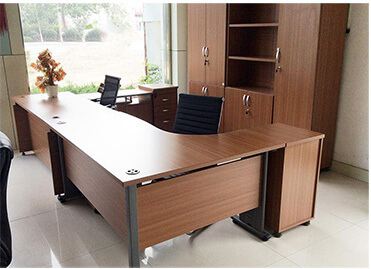
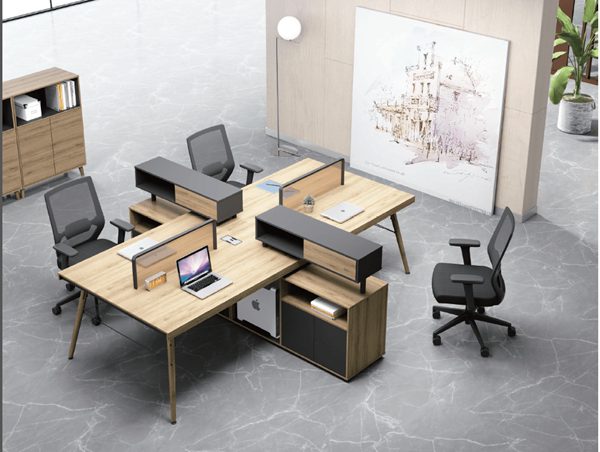
| Office Furniture | Desks, cabinets, shelves, and office workstations |
| Custom Furniture | Made-to-order furniture panels and customized components |
| Panel Furniture Factories | Batch processing of MDF, plywood, and particleboard |
| Furniture OEM Production | Multi-order panel cutting and component identification |
Compatible materials depend on the cutting tools, spindle power, vacuum system, and machine configuration.


Frequently Asked Questions
Nesting is the practice of arranging different part shapes on a single board so the sheet is used efficiently. A CNC nesting machine executes that arrangement with a router spindle: it cuts the outline of each part, drills system holes and mills grooves directly from the board, without saw blades and without re-clamping. Because the parts are cut from one sheet in one program, nesting suits mixed batches and custom sizes that a panel saw handles poorly.
Robotic loading replaces the manual or semi-manual feeding step. Instead of two operators lifting and aligning each board, the loading unit picks a board from the stack, positions it against the reference stops and hands it to the table vacuum — then repeats. This is what allows the cell to keep running between operator rounds.
Panel labeling is the part most plants underestimate. Before the spindle starts, the system prints a label containing the part ID, barcode or QR code, board material, dimensions and edge-banding notes, and applies it to the panel surface. When the part is cut and unloaded, the label stays with it. Downstream stations scan instead of search.
Put together, these three functions turn a cutting machine into a trackable production cell: the board goes in unidentified, and every part comes out carrying its own instructions.
Melamine and laminated particle board, MDF/HDF, plywood, blockboard and HPL-faced panels within the thickness range in the specification table.
Yes, with the ATC head performing drilling and grooving in the same clamping as the nesting cut, provided the required tools are in the magazine. Confirm your hole pattern against the tool count in the specification.
The compatible panel dimensions and weights depend on the robotic arm’s payload, reach, gripping system, and machine configuration. These parameters should be confirmed before ordering.
It may be integrated into a larger furniture production workflow with compatible unloading, sorting, conveying, and edge banding equipment. The required layout and communication interfaces need to be evaluated.
The operator scans the part and knows immediately which unit it belongs to, which edge needs banding and which direction it faces. It removes the manual matching step that causes mismatched panels and re-cuts.
Why Choose iGOLDENCNC?
iGOLDENCNC specializes in CNC woodworking machinery and automated panel furniture production solutions.
We understand that modern furniture manufacturers need more than individual cutting equipment. They need coordinated production processes that connect material handling, panel identification, CNC machining, and downstream operations.
Our CNC nesting solutions can be configured according to different factory layouts, panel specifications, furniture production requirements, and automation targets.
Whether you operate a custom cabinet workshop or a large-scale panel furniture factory, iGOLDENCNC can help evaluate a suitable robotic loading, automatic labeling, and CNC nesting solution.